Why Site Inspection Matters Before Choosing a Side Stream Filtration System
Across the UAE, we keep seeing the same mistake repeated on side stream filtration projects. Many customers select side stream filtration systems from a catalogue or a generic spec sheet, without anyone visiting the site to inspect the actual water conditions.
The first question should always be: What is really in the water, and where is it coming from?
Factors such as dust, sand intrusion, rooftop exposure, makeup water source, and even the height and location of the cooling tower all change the quality of water. Ignoring these site-specific conditions results in an expensive filtration skid that looks right on paper but delivers poor performance in the field.
Real Case: Rooftop Hotel Cooling Tower in a High-Dust Environment
We recently inspected a hotel project where the cooling towers were installed on the rooftop — fully exposed to open desert dust, construction activity nearby, and strong seasonal shamal winds. The consultant/contractor had specified a centrifugal separator (cyclone separator) for side stream filtration.
On paper, centrifugal separators are a solid, low-maintenance choice — no media to replace, low pressure drop, continuous operation. But there’s a catch: they only remove particles that are denser than water, and typically only particles larger than roughly 45–75 microns settle out efficiently, reducing overall water quality and limiting the effectiveness of the filtration system.
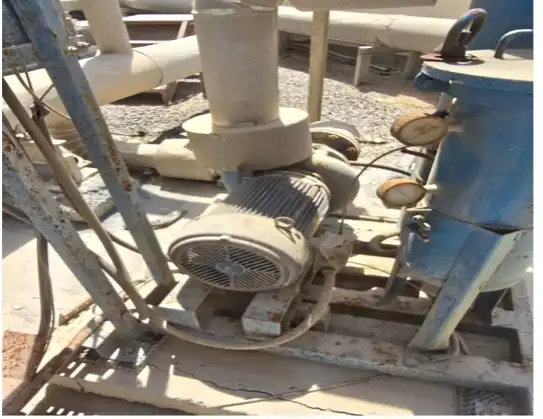
(Found on a hotel rooftop cooling tower plant: a centrifugal separator, corroded and unmaintained. The client couldn’t identify the equipment or explain its purpose — a clear sign that filtration selected without site awareness often ends up forgotten, not fixed)
In this rooftop environment, the dust load was extremely high, but a large fraction of it was fine airborne dust and light particulate — exactly the kind of material a cyclone separator struggles to capture. The result: the cooling tower basin continued to accumulate silt, the fill started fouling faster than expected, and the separator was, in practice, doing very little useful work relative to the dust ingress it was facing.
In our opinion, this site called for a disc filter, not a centrifugal separator.
Automatic disc filters (or fine screen filters) can capture much finer particulate — often down into the 20–100 micron range depending on disc grade — and they self-clean via automatic backwash on differential pressure, which matters a lot in a high-dust environment where the filter is going to be loading up constantly. For a rooftop hotel cooling tower sitting directly in dust-heavy, wind-exposed conditions, a disc filter gives far better real-world particulate control than a cyclone separator ever will.
Now take a cooling tower in a lower-dust environment — for example, a ground-level or semi-enclosed plant room location, shielded from direct wind-blown sand, or a site using relatively cleaner makeup water (rather than sitting in an open, exposed, high-particulate rooftop condition).
In this case, our preference shifts:
- Centrifugal separator as the primary stage — to knock out the heavier sand and silt particles cheaply and with minimal maintenance, and
- Bag filter as a secondary/polishing stage — to catch the finer residual particulate that the cyclone can’t remove.
This combination works well precisely because the dust loading is lower. The cyclone isn’t overwhelmed, and the bag filter isn’t loading up so fast that it becomes a constant replacement cost. In a high-dust rooftop condition, the same bag filter would need changing far too frequently to be practical or economical.
The Real Lesson: Match the Filter to the Site, Not the Spec Sheet
This is really the point of this article. Filtration technology selection for UAE cooling towers should never be a copy-paste decision. Before specifying anything, ask:
- Where is the cooling tower physically located? Rooftop and wind-exposed vs. ground-level and sheltered behave completely differently.
- What is the dominant contaminant type? Fine airborne dust vs. coarser sand/silt vs. biological fouling — each needs a different filtration approach.
- What is the makeup water source and quality? Municipal water vs. well water vs. TSE (treated sewage effluent) reuse water all carry very different particulate and biological loads, which is especially relevant in the UAE given the wide use of TSE for cooling tower makeup.
- What is the realistic maintenance capacity on site? A high-dust rooftop system with bag filters will demand far more frequent bag changes than the facilities team may be budgeting for.
- Seasonal factors — the UAE’s shamal (dust storm) season can dramatically spike particulate loading for weeks at a time; the filtration system needs to handle that peak, not just average conditions.
Our Recommendation Framework
Site Condition
Rooftop, high dust, wind-exposed |
Ground level / sheltered, low dust |
TSE or well water makeup |
Small system, budget constrained, low dust |
Dominant Contaminant
|
Fine airborne dust, silt |
|
Coarser sand/silt |
|
Biological growth, fine solids |
|
General solids |
Recommended Approach
Automatic disc or media/sand filter for very high loads |
Centrifugal separator + bag filter (polishing) |
Media or disc filter, often paired with biocide dosing |
Bag/cartridge filter alone (with maintenance planning) |
Final Thought
Side stream filtration isn’t a checkbox item — it’s a site-specific engineering decision. In our experience across UAE HVAC projects, the single biggest driver of poor cooling tower water quality isn’t the absence of filtration, it’s filtration that was selected for the wrong environment. A quick site walk, a look at the surroundings, and an honest assessment of dust and makeup water conditions before specification can save significant fouling, chemical treatment cost, and premature fill/coil replacement down the line.
If you’re specifying or reviewing a cooling tower filtration system in the UAE, don’t just check the model number — check the roof.